Most SEO advice is written with consumer businesses in mind. Find the biggest keywords, publish content that ranks for them, and watch traffic climb. For a B2B company, that playbook often produces a traffic graph that looks great and a sales pipeline that doesn't move.
B2B buying works differently, so B2B SEO has to work differently too. This guide covers why volume-first thinking falls short, the searches that actually reach decision makers, the content formats that turn research into conversations, the technical issues specific to B2B and SaaS sites, and how to measure SEO in a way your sales team will recognise.
Why B2C thinking fails in B2B
Three things set B2B buying apart.
- Long journeys. A consumer might search, compare and buy in an afternoon. A business purchase can take months, with research spread across many sessions, devices and people.
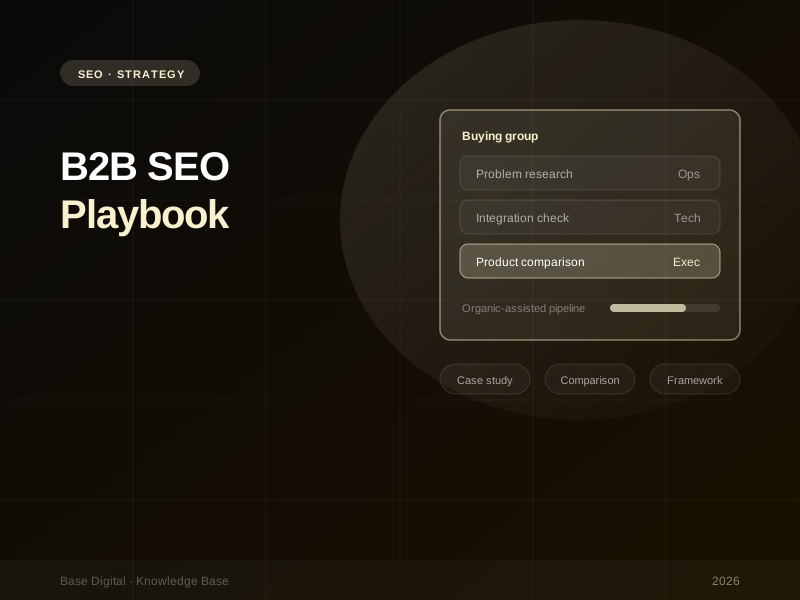
- Multiple stakeholders. The person who first finds you is often not the person who signs off. An operations manager researches the problem, a technical lead checks integrations, finance reviews the cost and an executive approves it. Each searches for different things.
- High deal values. When one customer is worth a significant amount, a page that brings in a few qualified visitors a month can be worth far more than a page that brings in thousands of casual readers.
Put together, this means search volume is a weak guide to value. A low-volume, highly specific query typed by someone halfway through an evaluation is often worth more than a broad head term that attracts students, job seekers and competitors' staff.
"In B2B, the right ten visitors are worth more than the wrong ten thousand."
The queries that reach decision makers
Instead of starting with the biggest keywords in your category, start with the questions your buyers ask at each stage of their evaluation. Three types of query consistently matter.
1. Comparison and alternatives queries
Late in an evaluation, buyers search for comparisons: "[product type] for [industry]", "[your product] vs [competitor product]", or "alternatives to [competitor product]". These searches come from people who already understand the problem and are choosing a solution. They're often low in volume and high in intent.
2. Problem-awareness queries
Earlier on, buyers search for the problem, not the product. They might not yet know your category exists. Queries like "how to reduce [specific operational issue]" or "why is [process] taking so long" reach people at the moment they're defining what they need. Content that frames the problem well puts you on the shortlist before the shortlist exists.
3. Role-specific queries
Each stakeholder in a buying group searches through their own lens. A technical evaluator looks for integration details, security documentation and implementation requirements. A finance lead looks for pricing models and total cost of ownership. An executive looks for outcomes and risk. If your content only speaks to one of these roles, you're absent from part of the decision.
The best source for all three query types is not a keyword tool. It's your sales team. Ask them what prospects ask on first calls, which objections come up, and which competitor products get mentioned. Then check those themes against search data to find the phrasing people actually use.
Content formats that convert
B2B buyers are researching a significant decision. They want evidence, specifics and honesty. Three formats consistently do this well.
Case studies
A strong case study shows a specific business with a specific problem, what was done, and what changed. Structure it so it can be found: name the industry, the problem and the type of solution in the title and headings, so it ranks for searches like "[solution] for [industry]". Only publish real outcomes your customer has approved, and be precise about what you can and can't attribute to your product.
Honest comparison pages
If buyers are searching to compare your product with a competitor's product, someone is going to answer that query. It might as well be you. A good comparison page is genuinely useful: it explains who each product suits, where yours is stronger and, crucially, where it isn't. Buyers can tell when a comparison is one-sided, and a page that admits a competitor's product is better for a particular use case earns trust for everything else it says.
Keep comparison pages factual and current. Compare features, pricing models and fit based on publicly available information, date the page, and review it whenever either product changes. An outdated comparison does more harm than none at all.
Frameworks and practical guides
Problem-awareness content works best when it gives the reader something they can use: a framework for evaluating options, a checklist for implementation, a template for building a business case. These are the pages that get bookmarked, shared with colleagues and forwarded to the person who signs off. Organise them into topic clusters around your core problems so each guide supports the others and strengthens the whole topic.
Write for the forward. Assume every strong B2B page will be sent to someone who wasn't part of the original search. Make the key point clear in the first few paragraphs, and make the page make sense on its own.
Technical priorities for B2B and SaaS sites
B2B and SaaS sites share a few technical issues that consumer sites rarely face.
- Keep app URLs out of the index. Logged-in application screens, dashboards, account pages and staging environments shouldn't appear in search. Use
noindex, authentication and sensible robots rules so search engines focus on your marketing pages, and make sure login pages aren't competing with your homepage for brand searches. - Check JavaScript rendering. Many SaaS marketing sites are built with JavaScript frameworks. Google can render JavaScript, but critical content, links and metadata should be available in the rendered HTML without relying on user interaction. Use the URL Inspection tool in Search Console to see what Google actually renders, and follow Google's JavaScript SEO basics.
- Manage frequent product changes. Features get renamed, plans get restructured and pages get retired. Every one of those changes is a chance to lose rankings. Redirect retired URLs to the closest relevant page, keep canonical tags accurate when similar pages exist, and update internal links rather than relying on redirect chains.
- Separate documentation and marketing intent. Help centres and developer docs can rank well and attract evaluators, but they need clear paths back to product and pricing pages so researchers can move forward.
Our technical SEO checklist covers the broader foundations every site needs.
The AI search angle
B2B buyers increasingly start their research in AI tools like ChatGPT and Gemini, and in Google's AI Overviews. They ask for shortlists, comparisons and explanations, often with detailed context about their industry and requirements. The answers they get are shaped by what's published across the web about your category and your product.
The content that performs well in traditional B2B search tends to perform well here too: clear explanations of who your product is for, honest comparisons, specific use cases and well-structured pages that state facts plainly. Make sure your own site describes your product, integrations, pricing model and ideal customer clearly and consistently, so AI tools have accurate material to draw from. Vague positioning is easy to ignore. Specific, consistent information is easy to cite.
Measure pipeline, not traffic
The fastest way to lose trust in an SEO program is to report traffic growth to a sales team whose pipeline hasn't changed. Measure what the business cares about:
- Organic-sourced leads. Enquiries, demo requests and sign-ups where organic search was the first or last touch. Pass the source into your CRM so it stays attached as the lead progresses.
- Organic-assisted pipeline. Deals where organic search appeared anywhere in the journey. Given how long B2B journeys run, this is often a truer picture of SEO's contribution than last-click data.
- Demo and trial sign-ups. Track these as key events in your analytics, broken down by landing page, so you know which content actually starts conversations.
- Keywords that close. Work with sales to identify which topics and queries lead to deals, not just leads. Over time, this tells you where to invest content effort.
That last point is where SEO and sales alignment pays off. A short regular review of which organic leads became customers, and what they searched or read along the way, will sharpen your keyword strategy faster than any tool.
Putting it together
A practical B2B SEO program usually looks like this:
- Interview sales and customer success to map buyer questions by stage and role.
- Prioritise comparison, problem-awareness and role-specific topics over raw volume.
- Build case studies, honest comparison pages and practical frameworks, organised into clusters.
- Fix the technical basics, especially indexing, rendering and redirects.
- Track leads and pipeline through to your CRM, and review the results with sales regularly.
The bottom line
B2B SEO isn't about winning the biggest keywords. It's about being present, credible and useful at each point where a buying group is researching a decision, and proving that presence turns into pipeline. Fewer, better pages aimed at the right people will outperform a high-volume content calendar almost every time.
To organise that content so it builds authority over time, read our guide to content cluster strategy. If you'd like a B2B SEO plan built around your sales process, talk to us about SEO.