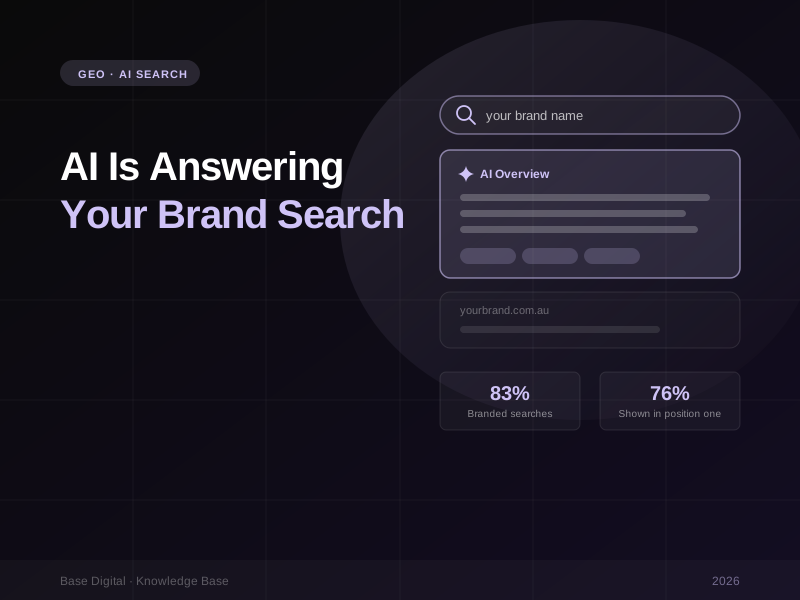
Search your own brand name on Google today and there's a good chance the first thing you'll see isn't your website. It's an AI Overview: a Google-written summary of who you are and what you do, stitched together from sources you may or may not control.
A new Ahrefs study published on 2 October 2026 analysed 232.8 million US desktop search results from July to September. On 29 September, AI Overviews appeared on 82.91% of branded searches. Across the whole of September, the monthly average was 73.3%, up from 61.3% in July.
| Month (2026) | Branded searches with an AI Overview | Non-branded searches with an AI Overview |
|---|---|---|
| July | 61.3% | 73.5% |
| August | 65.1% | 74.7% |
| September | 73.3% | 78.3% |
That's a big reversal. Less than a year ago, Ahrefs' earlier research found AI Overviews on just 13.1% of branded queries. Brand searches used to be the safe zone, where people typed your name and clicked straight through to your site. That's no longer guaranteed.
A quick caveat: this data is US desktop only, and the 83% figure is a single-day snapshot. Australian results may differ, and Google changes its AI features constantly. But the direction is clear, and it's worth acting on now.
Why this matters for your brand
The AI Overview usually sits on top. In Ahrefs' sample of 100 major brand names, 63 showed an AI Overview by the end of September. Of those, 48 appeared in position one, above the brand's own website.
Other people are telling your story. The most-cited external sources in those branded AI Overviews were Wikipedia (71.9%), YouTube (38.6%) and LinkedIn (22.8%). Facebook and retailers also featured. That means a reviewer's YouTube video, an old LinkedIn post or an out-of-date directory listing can shape how Google describes you to people who are actively looking for you.
Fewer people click through. Ahrefs' separate research found a 58% lower click-through rate for the top-ranking page when an AI Overview is present. For branded searches, the bigger worry isn't lost clicks. It's that someone forms an impression of you before they ever reach your website.
The good news is that Google rarely pulls competitors into these answers. Ahrefs found only 2 of 58 branded AI Overviews mentioned competitors. The risk isn't being replaced by a rival. It's being described inaccurately, incompletely or by sources you don't control.
1. Audit what AI is saying about you
Start by looking. Google your brand name, your brand plus "reviews", "pricing", "location" and your main services. Screenshot every AI Overview and note which sources it cites. Then ask ChatGPT, Gemini and Perplexity the same questions.
You're checking three things: is it accurate, is it current, and where is it getting its information? Any wrong prices, old addresses, discontinued products or missing services become your to-do list.
2. Make your own site the clearest source of truth
AI tools pull from pages that answer questions directly. Make sure your website does that, clearly and in plain language:
- An About page that states who you are, what you do, where you operate and who you serve.
- Service and product pages that open with a one-or-two-sentence answer before the detail.
- An FAQ section covering the questions people actually ask about your brand.
- Organisation, LocalBusiness and Product schema markup, kept up to date.
- Consistent business name, address and phone number everywhere.
If Google can't find a clear answer on your site, it will find one somewhere else.
3. Own your third-party profiles
Wikipedia, YouTube and LinkedIn are clearly trusted sources, so treat them as part of your website. Update your LinkedIn company page with an accurate description, services and locations. Start or refresh a YouTube channel with short videos explaining what you do, your products and your FAQs.
The same goes for Google Business Profile, Facebook, industry directories and review platforms. If a third-party video or article about you is out of date, publish a better, more current one yourself.
4. Earn mentions in places AI trusts
AI tools give weight to what others say about you. Earned coverage, industry "best of" lists, podcast appearances, partner pages and genuine reviews all help build a consistent picture of your brand across the web.
This is where traditional PR and digital PR overlap with GEO. Every credible mention that describes you accurately is another source that reinforces your story.
5. Keep your brand search covered with paid
If an AI Overview is taking the top spot on your brand name, a branded Google Ads campaign keeps your own message, offer and link right there in the results. Brand campaigns are usually cheap to run and protect you from competitors bidding on your name too.
Pro tip: Track it over time. Check your branded click-through rate in Google Search Console, and repeat your AI audit every quarter. Tools like Ahrefs Brand Radar can monitor how AI Overviews mention and cite your brand at scale.
The bottom line
Your brand name used to be the one search you could count on owning. Now Google's AI often answers it first, using whatever sources it trusts. You can't switch AI Overviews off, but you can make sure the information they draw on is accurate, current and coming from you.
New to the topic? Start with our guide, What is Generative Engine Optimisation and why does your brand need it now? Or if you'd like to know exactly what AI is saying about your brand, talk to us about a GEO audit.