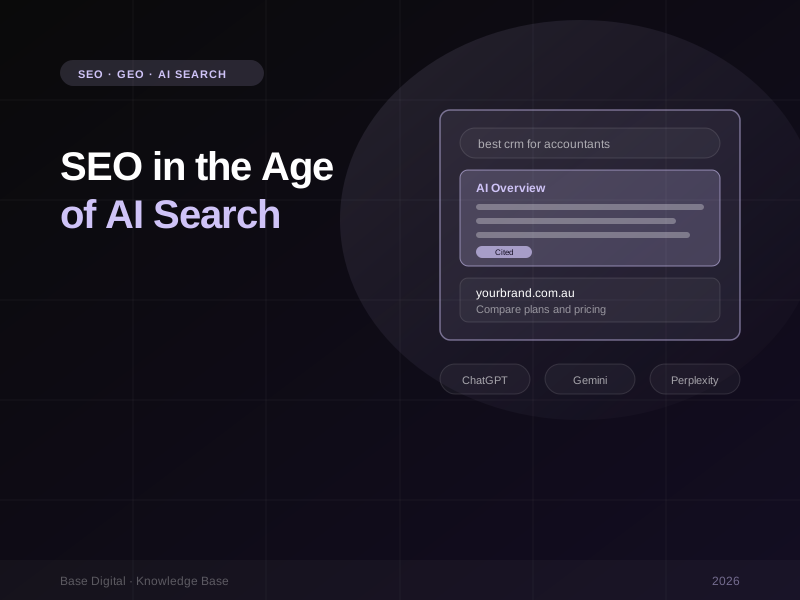
- GEO (Generative Engine Optimisation) is the discipline of making your brand visible inside AI-generated answers — not just traditional search results.
- Google AI Overviews, ChatGPT Search and Perplexity now answer millions of queries directly, bypassing the standard blue-link results most brands optimise for.
- AI engines cite sources based on authority, clarity, structure and topical depth — not keyword density.
- GEO and SEO are complementary, not competing disciplines. You need both, but they require different strategies.
- Brands that act on GEO now will build a citation advantage that latecomers will struggle to close.
Search has changed more in the past two years than in the previous decade. And most brands are still optimising for a version of search that is rapidly becoming secondary.
When someone asks ChatGPT which accountant to use in Brisbane, or asks Google "what's the best project management software for a 10-person team," they are no longer getting a list of ten blue links. They are getting a synthesised, conversational answer — drawn from sources that AI engines have deemed credible, clear and relevant. Your brand either appears in that answer or it doesn't.
This is the new battleground. And it has a name: Generative Engine Optimisation, or GEO.
What is Generative Engine Optimisation?
Generative Engine Optimisation is the practice of structuring your brand's content, authority signals and online presence so that AI-powered search engines — including Google's AI Overviews, ChatGPT Search, Perplexity, Microsoft Copilot and emerging AI agents — cite, surface or recommend your brand in their generated responses.
The term was formalised in academic research from Princeton, Georgia Tech and IIT Delhi in 2023, and it has since become one of the most important emerging disciplines in digital marketing. Where traditional SEO asks "how do we rank on page one?", GEO asks a harder question: "how do we become part of the answer itself?"
It is worth being precise about what GEO is and is not. GEO is not about gaming AI engines the way old-school black-hat SEO gamed Google's algorithm. AI language models are considerably harder to manipulate at a keyword level. GEO is fundamentally about being genuinely authoritative, clear and useful — and then ensuring that authority is structured and signalled in ways AI engines can recognise and trust.
How AI search engines decide what to cite
To do GEO well, you need to understand how AI-generated answers are actually constructed. The mechanics vary by platform, but there are consistent patterns across Google AI Overviews, ChatGPT Search and Perplexity.
Each of these systems performs a retrieval step — they pull potentially relevant content from the web or their index — and then a synthesis step, where they summarise and blend that content into a coherent answer. The retrieval step is where your content needs to appear. The synthesis step is where your brand gets cited.
Relevance and topical authority are the first filter. AI engines assess whether your content is genuinely about the topic being queried, and whether your broader site has depth on that topic. A single well-optimised page rarely beats a site with a genuine content ecosystem around a subject.
Source credibility matters significantly. AI engines weight sites with strong backlink profiles, established domain histories and signals of genuine expertise — consistent with E-E-A-T (Experience, Expertise, Authoritativeness, Trustworthiness) as Google defines it. Thin sites with purchased links perform poorly in AI citation, even if they rank adequately in traditional search.
Content structure is a critical differentiator. AI engines scan for clearly answered questions, well-defined claims with supporting reasoning, and content that is easy to excerpt. Long walls of unbroken text that work fine for human readers are harder for AI to parse cleanly. Headers, clear topic sentences, concise definitions and well-structured lists all improve your likelihood of being cited.
Recency and freshness signals influence which sources AI engines prefer when the query touches a fast-moving topic. Stale content published in 2019 and never updated is increasingly a liability.
"The brands getting cited in AI answers right now aren't the ones who spent the most on ads. They're the ones who built the most authoritative, well-structured content on topics their customers actually ask about."
GEO vs SEO: what's the same and what's different
GEO and traditional SEO share a foundation. Both reward genuine expertise, strong backlink authority and technically healthy websites. The work you have done on SEO is not wasted — it is often a prerequisite for GEO success. A site with zero domain authority and no content depth is not going to be cited by AI engines regardless of how cleverly it is structured.
But there are meaningful differences in how you need to approach content creation.
Traditional SEO has long been keyword-centric. You identify a keyword, you optimise a page for that keyword, you track that keyword's position. GEO is topic-centric and answer-centric. AI engines are not matching keywords — they are understanding intent, and they are looking for content that clearly, accurately and completely answers the questions implicit in that intent.
Traditional SEO rewards click-through optimisation — you want someone to click your result. GEO success can look like zero-click visibility — your brand is cited in an AI answer that the user never clicks away from. This has real implications for how you measure the channel and how you think about content investment.
GEO also puts a higher premium on brand signals. AI engines are more likely to cite branded entities with clear identity signals — an authoritative About page, named authors with credentials, consistent brand mentions across external sources. The faceless content site approach that worked in SEO five years ago is a non-starter for GEO.
Why the window to act is now, not later
One of the dynamics I watch closely is how AI citation patterns tend to calcify. Early entrants in a topic area accumulate citations, which reinforces their authority signals, which drives more citations. The compounding effect of being an early established source in your niche is significant.
We are currently in the early adoption phase of GEO. Most brands are not thinking about it deliberately. Their competitors are not thinking about it deliberately. The gap between brands that act now and those that wait 18 months will be difficult to close once it opens.
There is also a platform adoption curve to consider. In 2024, AI search was a novelty. In 2026, it is a mainstream behaviour. Research suggests that a significant and growing share of informational queries — particularly in the awareness and consideration phases of the buying journey — are now being answered primarily by AI engines. The categories being hit hardest first are health, finance, technology and professional services. But the pattern is spreading.
The practical implication: If you sell a considered product or service where buyers do research before purchasing — and that includes almost every B2B category and most high-value B2C categories — AI search is already part of your buyer's journey. Your brand's presence (or absence) in those AI answers is shaping purchase intent right now.
5 practical GEO tactics to implement now
GEO is a long-term discipline, not a quick fix. But there are high-leverage starting points that move the needle quickly.
1. Build genuine topical authority through content depth
Identify the 10–15 core questions your ideal customer asks when researching your category. Then build genuinely excellent, comprehensive content that answers each question in depth. Not thin blog posts optimised for keywords — full, expert-level explanations that would satisfy a curious, intelligent buyer. AI engines reward depth and completeness. A well-structured 2,000-word piece that fully covers a topic will outperform ten 300-word pieces every time in AI citation scenarios.
2. Structure your content for AI parsing
Use clear H2 and H3 headers that are formatted as questions or topic descriptors. Open each section with a direct answer before elaborating. Use short, declarative sentences for key claims. Include definitions — AI engines love content that clearly defines terms, because it can be cleanly excerpted. Bullet lists and numbered steps are highly citable formats.
3. Strengthen your E-E-A-T signals
Make sure your site clearly communicates who you are, what your expertise is, and why you should be trusted. Named authors with bylines and credentials, an authoritative About page with genuine company history, clearly cited references for factual claims, and a consistent NAP (Name, Address, Phone) for local businesses. These signals are increasingly important for AI citation, and most brands have done a poor job building them.
4. Get cited by authoritative external sources
AI engines are more likely to cite sources that are themselves cited by credible publications. This means earned media, industry publication features, podcast appearances, expert commentary in trade press and genuine backlinks from authority sites still matter — but now they matter for AI visibility as much as for traditional search rankings. A deliberate PR and link-building programme is a GEO strategy, not just an SEO strategy.
5. Create definition and FAQ content around your key concepts
One of the most reliably cited content formats in AI answers is definitional content — "what is X?", "how does X work?", "what's the difference between X and Y?" If your brand is the clearest, most authoritative source for definitions and explanations of key concepts in your industry, you will get cited when those concepts come up. Invest in a Knowledge Base or Resources section that treats your expertise seriously.
How to measure GEO performance
Measurement is the frontier of GEO right now. Unlike traditional SEO, there is no equivalent of Google Search Console for AI citation tracking — at least not yet. But there are practical approaches.
Manual prompt testing is the starting point: regularly query AI engines with the questions your customers are likely asking, and track whether and how your brand appears in the responses. Tools like Perplexity, ChatGPT and Google AI Overviews can all be queried directly. Build a set of 20–30 representative prompts for your category and test them on a monthly basis.
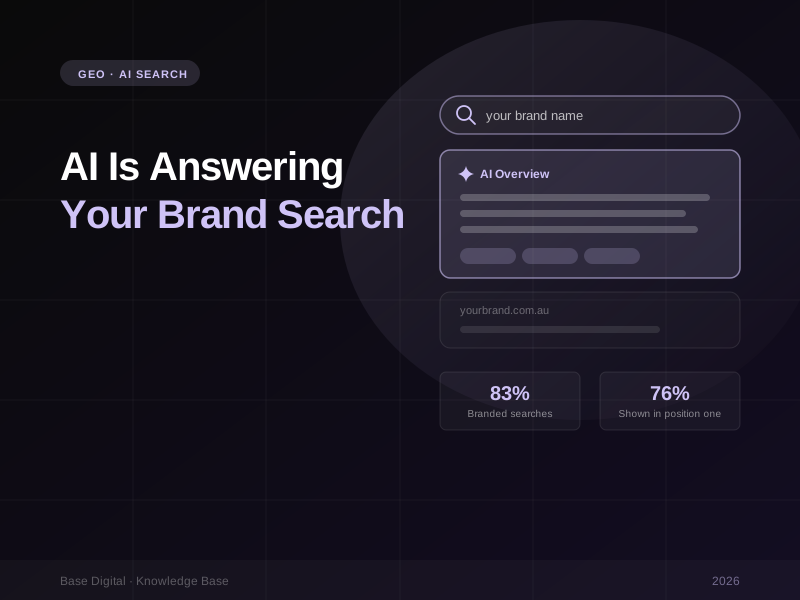
Brand mention monitoring via tools like Ahrefs, Mention or BrandMentions will show you when your brand is being cited across the web — including in AI-generated content that gets published. Watch for indirect citation signals too: traffic patterns shifting toward branded searches can indicate growing AI-driven brand awareness.
Over time, expect dedicated GEO analytics tools to emerge. For now, the brands that are building the habits of GEO measurement — even imperfectly — will be better positioned when more sophisticated tracking becomes available.
The bottom line
GEO is not a trend to watch. It is a shift in how discovery works, and it is happening now, at scale, across the categories where considered buying decisions are made. The brands that build genuine topical authority, structure their content for AI citation, and invest in the credibility signals AI engines reward will compound that advantage over the next two to five years.
The brands that are still treating AI search as a future problem will find, probably within 18 months, that it has become a current crisis. The time to act is before the gap opens, not after.
At Base Digital, GEO is now a core part of how we think about content strategy and SEO for every client. If you want to understand where your brand stands in AI search — and what it would take to become a consistently cited source in your category — that is exactly the kind of audit we do.