- The best agency for your business is not the biggest, the cheapest, or the one with the most awards. It is the one that understands your business model and will tell you the truth.
- Ask about who actually does the work — not who presents in the pitch. Junior execution under senior sales is a common agency failure mode.
- Transparency is not just a value. It is something you should be able to see and verify: in reporting, in access, in how they explain performance.
- Watch for agencies that promise specific rankings or guaranteed results. Anyone promising rank #1 on Google is either lying or unaware of how search works.
- Cultural fit matters more than you think. You will be working closely with these people. The relationship needs to work at a human level, not just a commercial one.
I have been running a digital marketing agency for 14 years. I have won clients and I have lost clients. I have seen the industry from the inside — how agencies are structured, how pitches are won, where corners get cut, and what genuine client service actually looks like versus what gets promised in a proposal.
So I want to write this as honestly as I can — even though I am, obviously, an agency founder writing an article that will be read by people who may be considering hiring an agency. I am going to give you the framework I would give a friend who asked me how to choose a digital marketing agency. Including the questions that would make a mediocre agency uncomfortable to answer.
Start with clarity on what you actually need
Before you speak to any agency, get clear on two things: what your actual goal is, and what channels or services you believe you need to achieve it. These are not the same question.
Your goal might be "grow eCommerce revenue by 30% in the next 12 months." The services you need to achieve that could be SEO, paid media, email, or some combination. The mistake many businesses make is going to market for a specific service ("we need Google Ads management") before they have validated that Google Ads is actually the right tool for their goal. A good agency will challenge that assumption if it needs challenging. A bad one will simply take the brief and run ads.
Also be clear on your budget. You do not need to lead with it, but you should know it. Budget shapes what is realistic, which channels can be viably activated, and what level of agency you can meaningfully engage with. A $1,500/month budget is not going to get you a senior team running a multi-channel programme. Know your number and be realistic about what it can deliver.
The 8 questions to ask any agency
These questions are designed to surface the information that proposals and pitch decks rarely volunteer. Ask all of them. Pay close attention to the ones that produce hesitation.
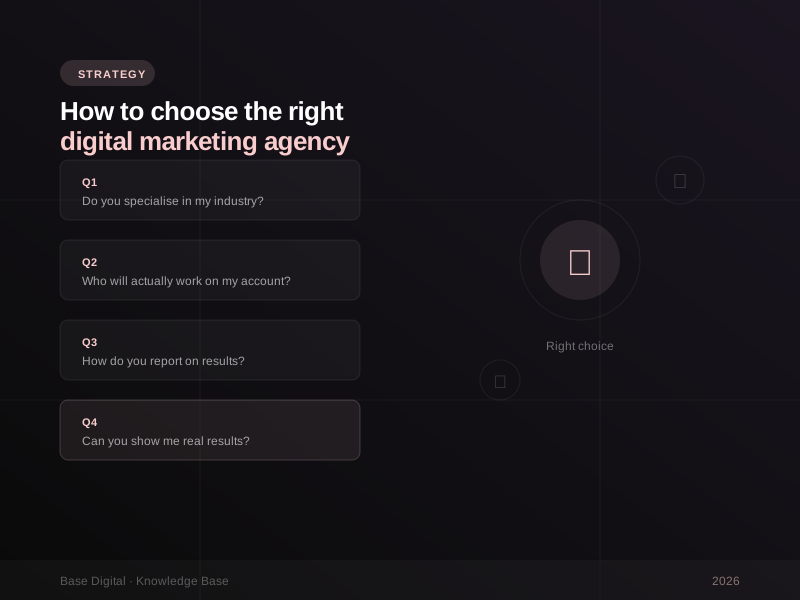
- "Who will actually be working on my account day to day?" Pitches are often run by senior people who will not touch your account after signing. Find out specifically who your account manager or lead strategist will be, what their experience level is, and whether they are the person presenting to you today.
- "Can I speak to two or three current clients in a similar category to mine?" References are the clearest signal of actual performance. Any agency confident in their work will provide them without hesitation. If they hedge, ask why.
- "What does your reporting look like, and can you show me an example?" Request an anonymised version of a real client report. Does it show the metrics that matter for business outcomes, or does it show vanity metrics dressed up as results? Can you trace the numbers back to revenue impact?
- "Who owns the accounts, assets and data if we part ways?" You should own your Google Ads account, your Meta Business Manager, your Search Console, your Klaviyo account. Everything. If an agency retains ownership of any of your marketing accounts or assets, do not engage them.
- "What does a bad month look like, and how do you handle it?" Every account has bad months. The answer to this question tells you how the agency communicates under pressure — proactively and honestly, or quietly hoping you do not notice.
- "What are your fees, and is there any margin on ad spend?" Some agencies charge a management fee and also take a percentage margin on the media spend they place on your behalf — without disclosing it. This is a conflict of interest. Fees should be transparent and separated from media spend.
- "What would you not do for a client in my category?" A good agency has principles about what they will and will not take on. An agency that will do anything for anyone is not a strategic partner — they are a vendor. Listen for what they decline, not just what they offer.
- "What does success look like for us in 90 days, and in 12 months?" This question tests whether the agency has actually thought about your specific situation, or whether they are giving a templated answer. The 90-day answer should be specific and grounded. The 12-month answer should be ambitious but credible.
"The best thing an agency can do in a pitch is disagree with you about something. It means they are thinking independently — not just telling you what you want to hear."
Three red flags to watch for
Red flag 1: Guaranteed results and specific ranking promises
If an agency promises to get you to "rank #1 on Google" or guarantees a specific ROI figure before they have audited your accounts and understood your market, walk away. Search rankings are not contractually deliverable. ROI projections before a proper discovery process are fiction. Agencies making these promises are either uninformed about how the platforms work, or they are willing to say what it takes to win the contract. Neither is a good foundation for a working relationship.
Red flag 2: Lock-in contracts with punitive exit clauses
A confident agency does not need a 12-month lock-in with heavy penalty clauses to retain clients. They retain clients by performing. Short notice periods (30–60 days is standard) protect you if the relationship is not working, and they are the norm at agencies that stand behind their work. Contracts that make it difficult and expensive to leave are a sign of an agency that knows clients want to leave.
Red flag 3: Vague or jargon-heavy reporting
Reporting full of impressions, reach and "brand awareness" metrics without connecting them to revenue impact is a classic agency smoke screen. If a report cannot answer the question "what did we generate for the money we spent?", it is not a useful report — it is a document designed to look busy rather than communicate performance. Insist on revenue-connected reporting from the start of any engagement.
What transparency actually looks like in practice
Transparency is a word every agency puts in their pitch deck. Here is what it looks like when it is real, rather than aspirational:
- You have direct access to all your advertising accounts, analytics and tracking dashboards — not filtered views, and not "we'll send you a report." Full access, always.
- When performance drops, you hear about it from the agency before you notice it yourself. The call is proactive, not reactive.
- Budget recommendations are explained with reasoning, not just presented as a number. "We recommend increasing your Meta budget by $2,000/month because the ROAS on your retargeting audiences is X and there is headroom to scale" is transparent. "We recommend increasing your budget" is not.
- The agency tells you when a channel or tactic is not working, even when telling you that means recommending a smaller scope of work for themselves. This is the clearest test of whether an agency is genuinely on your side or just managing their own revenue.
On cultural fit: This one is harder to define but easy to feel. You are going to be in a working relationship with these people for potentially years. They will know your revenue numbers, your growth challenges, your competitive pressures. You need to trust them — and trust is built on honesty, competence and respect. If something feels off in the pitch, it will not get better once the contract is signed. Pay attention to how they communicate, how they respond to hard questions, and whether you actually enjoy talking to them.
The difference between a good agency and a great one
A good agency executes competently. They manage your accounts well, hit their KPIs, communicate clearly and report honestly. That is the baseline. It is more than many agencies deliver, but it is the floor, not the ceiling.
A great agency thinks like a business partner. They understand your P&L well enough to know which growth moves are worth it and which are not. They push back when the brief is wrong. They bring you ideas you have not asked for. They connect marketing performance to business performance in their thinking and their reporting. They have skin in the game — not literally, but attitudinally. When you win, they feel it. When things go wrong, they own it.
The operational signal for this is simple: a great agency asks about your business model, your margins, your LTV and your customer acquisition economics before they recommend any channel or strategy. If the first conversation is entirely about what services they offer rather than what your business needs, you are talking to a good agency at best.
A word on choosing a Brisbane digital marketing agency
If you are a Brisbane-based business, you have genuine options — locally, nationally and internationally. The choice between a local agency and a remote or interstate agency is less important than the quality of the team and the fit with your needs. What matters is responsiveness, communication, and whether the people working on your account understand your market.
At Base Digital, we are a Brisbane agency and that matters to us — we know the market, we work with Brisbane businesses and national brands who want a team that is genuinely invested in what they are building. But I am not going to tell you that geography should be the deciding factor. Quality and fit should be. Those happen to be things we work hard at too.
Ask the eight questions. Watch for the three red flags. Insist on transparency you can see and verify. And choose the agency that talks to you honestly, not the one that tells you the most impressive story in the pitch room.