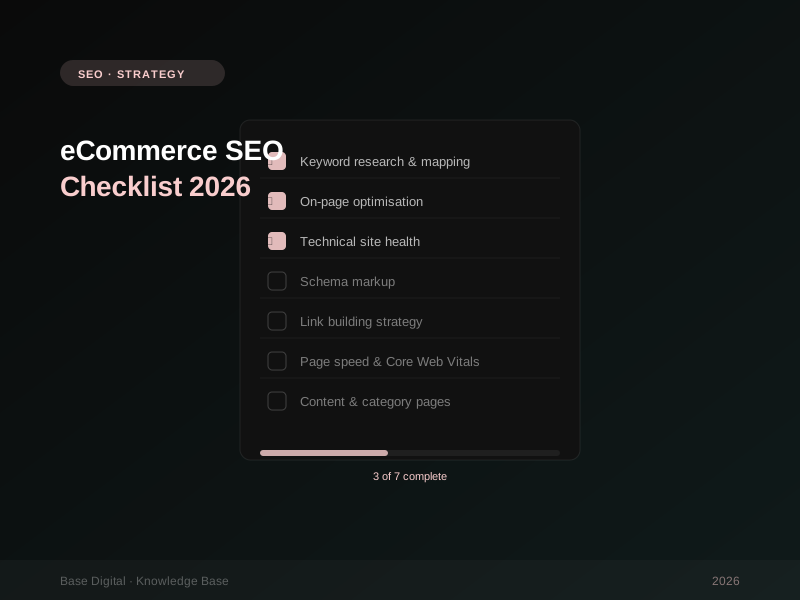
- eCommerce SEO requires a multi-pillar approach — technical issues alone, or content alone, won't move the needle sustainably.
- Category pages are the highest-value SEO real estate in most online stores. Most brands under-optimise them.
- Core Web Vitals are a ranking factor in 2026 and a conversion factor year-round. A slow store is an expensive store.
- Schema markup is not optional — Product, Review and BreadcrumbList schemas are the baseline for eCommerce and they directly impact rich result eligibility.
- AI search readiness — GEO — is the newest pillar. Your product and category content needs to be structured for AI citation, not just keyword matching.
Most eCommerce SEO advice falls into one of two failure modes: it is either too generic to be actionable, or it obsesses over one narrow tactic while ignoring the systemic nature of ranking in competitive categories. Real eCommerce SEO in 2026 requires work across multiple interconnected pillars simultaneously. Nail one and neglect the others, and you will plateau.
This checklist covers the seven pillars I use when auditing an online store. Each section has specific action items — not just principles. Work through them systematically and you will have a clear picture of where your store sits and exactly what needs to change.
Pillar 1: Technical SEO foundations
Technical SEO is the infrastructure everything else runs on. A store with technical errors is a store with a ceiling on its rankings, regardless of how good the content is.
- Crawlability: Crawl your store with Screaming Frog or Ahrefs Site Audit. Check for 4xx errors (broken pages), 5xx errors (server errors), and redirect chains (URL A redirects to B redirects to C). Fix every error above a threshold of impact.
- Indexation: Open Google Search Console and check the Coverage report. Identify pages that are excluded, noindexed, or blocked by robots.txt that should be indexed. Check that your XML sitemap is submitted, clean and up to date.
- Canonical tags: Every URL should have a self-referential canonical tag unless it is intentionally deferring to another URL. On Shopify specifically, product pages accessed via collection paths generate duplicate canonical issues — Shopify handles this natively, but confirm it is working correctly with a crawl check.
- HTTPS: Ensure every page loads on HTTPS. Check that HTTP URLs redirect properly to HTTPS and that there are no mixed content warnings (HTTP resources loaded on HTTPS pages).
- Mobile usability: Use Google Search Console's Mobile Usability report to identify specific pages with issues. Google indexes mobile-first, so mobile experience issues are indexation issues.
- Pagination: For category pages with multiple pages, ensure pagination is handled correctly. Rel="next"/"prev" was deprecated by Google but the underlying indexation logic remains relevant — ensure paginated pages are crawlable and that the first page is the canonical version.
Shopify-specific note: Shopify's default URL structure creates known duplicate content patterns — /collections/[collection]/products/[product] duplicates the canonical /products/[product] URL. Shopify applies canonical tags to manage this, but check it is working correctly and that you do not have the canonical pointing the wrong way.
Pillar 2: On-page optimisation for category and product pages
Category pages are the most important SEO real estate in most online stores — they rank for high-volume, high-intent category-level keywords. Yet most stores treat them as navigation elements rather than landing pages. That is a significant missed opportunity.
Category page optimisation
- Each category page needs a unique, keyword-targeted H1 that matches how buyers describe the category. Not "Footwear" — "Women's Trail Running Shoes."
- Include 200–400 words of original, useful content on every category page — above the fold or expandable below the product grid. This content should describe the category, include relevant keywords naturally, and answer the questions a buyer would have. Google needs content to understand what the page is about.
- Meta title: Include the primary keyword, ideally early. Add a conversion-relevant qualifier — "Shop," "Buy," "Free Shipping" — where natural. Keep under 60 characters.
- Meta description: Include the keyword, a value proposition and a soft call to action. Does not directly affect rankings, but affects click-through rate from search results.
- Faceted navigation: Filter and sort pages created by faceted navigation (e.g., /category?colour=red&size=medium) can create thousands of near-duplicate crawlable URLs. Noindex or disallow low-value filter combinations. Allow crawling of high-value ones (popular size or colour combinations with meaningful search volume).
Product page optimisation
- Unique product descriptions for every product. Manufacturer descriptions or copy-pasted text across variants is thin content and a duplicate content risk. Write descriptions that are informative, specific, and include relevant long-tail keywords naturally.
- Product H1 should include the brand, product name and key variant attribute where relevant: "Nike Air Max 270 — Black/White."
- Image alt text for every product image. Descriptive, specific alt text ("navy blue women's linen blazer — front view") rather than generic filenames or empty alt attributes.
- User-generated content (reviews, Q&A) adds natural keyword variation, fresh content signals and social proof. If you have reviews, surface them on product pages.
"Category pages are where most eCommerce SEO battles are won or lost. If yours are thin, generic and under-linked, you are handing rankings to competitors who treat them like proper landing pages."
Pillar 3: Content strategy and topical authority
Content beyond your product and category pages is how you capture the research phase of the buyer journey — the "best X for Y" searches, the "how to choose X" searches, the comparison and educational queries that happen before a buyer is ready to purchase.
- Build a content calendar targeting informational and commercial investigation queries in your category. Keyword research tools (Ahrefs, Semrush) can surface the specific terms your audience is searching for in research mode.
- Create genuinely helpful, comprehensive guides, buyer's guides, comparison articles and how-to content. Thin blog posts that exist to "add content" without genuinely answering a question do not rank, and they damage your E-E-A-T signal by demonstrating a low content quality threshold.
- Internal linking from content to relevant category and product pages is how you pass authority from your informational content to your commercial pages. Every piece of content should link to at least two or three relevant products or categories.
- Keep content fresh. Update high-performing content annually. Remove or redirect content that has never generated traffic and is not likely to. A leaner, higher-quality content library consistently outperforms a large archive of thin posts.
Pillar 4: Authority and link building
Domain authority, built primarily through external backlinks from credible sites, remains a significant ranking factor. In competitive eCommerce categories, the stores that rank consistently are almost always the ones with the strongest backlink profiles.
- Audit your current backlink profile in Ahrefs or Semrush. Identify your strongest links, your link gaps vs competitors, and any toxic links that should be disavowed.
- Prioritise earning links to your category pages, not just your homepage. A backlink to your "women's trail running shoes" category page passes authority directly to the page you want to rank for that term.
- Tactics that work for eCommerce link building: digital PR (product features, founder stories, industry commentary in relevant publications), supplier or brand partner links, resource page link building, blogger and influencer outreach for genuine product reviews (with editorial links, not paid nofollow placements).
- Competitor link gap analysis: Identify the sites linking to your competitors but not to you. These are warm prospects because they have demonstrated willingness to link in your category.
Pillar 5: UX, speed and Core Web Vitals
Google's Core Web Vitals — LCP (Largest Contentful Paint), INP (Interaction to Next Paint, which replaced FID in 2024), and CLS (Cumulative Layout Shift) — are confirmed ranking factors. But beyond rankings, they are conversion factors. A 1-second delay in page load time reduces conversions by approximately 7% on average. For a store doing meaningful revenue, that is significant.
- LCP (target: under 2.5 seconds): Usually the hero image or largest text block on a page. Optimise by compressing images (WebP format), preloading the LCP element, and using a CDN for asset delivery.
- INP (target: under 200ms): Measures responsiveness to interactions. Caused by heavy JavaScript blocking the main thread. Audit and defer non-critical third-party scripts (chat widgets, analytics, ad pixels) that run on page load.
- CLS (target: under 0.1): Visual stability — elements should not shift as the page loads. Specify dimensions for all images and embeds. Check that fonts load without causing layout shift (use font-display: optional or swap).
- Use Google PageSpeed Insights and the Core Web Vitals report in Search Console to identify pages failing the thresholds. Prioritise your most commercially important pages first — category pages, best-seller product pages.
- Shopify note: Shopify's online store 2.0 themes are generally better optimised out of the box than older themes, but third-party apps are the most common source of CWV degradation on Shopify. Audit every installed app for performance impact.
Pillar 6: Structured data and schema markup
Schema markup is code added to your pages that helps search engines understand the content — and unlocks rich results in search (star ratings, price, availability, breadcrumbs) that improve click-through rates.
- Product schema: Every product page should have Product schema including name, description, image, SKU, brand, offers (price, currency, availability) and, where available, AggregateRating (review data). This is what unlocks star ratings and pricing in search results.
- BreadcrumbList schema: Implement on every page to reinforce site structure and enable breadcrumb rich results in Google Search. Essential for eCommerce stores with deep category hierarchies.
- Review schema: If you have product reviews, implement AggregateRating and Review schema. Review stars in search results measurably improve CTR for product pages.
- FAQ schema: For category pages with FAQ sections, FAQ schema can generate accordion-style rich results in search and improves AI search citation likelihood.
- Validate all schema using Google's Rich Results Test. Check for errors and warnings in Google Search Console's Rich Results report.
On Shopify: Many Shopify themes include basic Product schema out of the box, but it is often incomplete — missing availability signals, incorrect price formatting, or absent brand fields. Audit your theme's schema output using the Rich Results Test before assuming it is correct. Gaps are common and easy to fix with a small JSON-LD addition.
Pillar 7: AI search readiness (GEO)
AI search readiness — or Generative Engine Optimisation (GEO) — is the newest pillar of eCommerce SEO, and the one most stores have not yet addressed. As Google AI Overviews, ChatGPT Search and Perplexity handle a growing share of research-phase queries, your store's content needs to be structured for AI citation, not just keyword matching.
- Structure category page content to answer specific questions directly. Use clear H2/H3 headers formatted as questions or topic descriptors. AI engines parse structured content more reliably than dense prose.
- Add definitional content where relevant: "What is [product type]?", "How to choose [product category]." These formats are reliably cited in AI answers when a buyer is in research mode.
- Ensure your brand has strong entity signals: clear About page, named team members with credentials, consistent brand mentions across external sources, and accurate structured data identifying your brand entity.
- E-E-A-T investment: Named authors for content, transparent expertise signals, cited sources for factual claims. AI engines are more likely to cite content from sources that demonstrate genuine expertise and trustworthiness.
- Build a FAQ section on category pages covering the most common buyer questions. These answer AI search queries directly and can generate FAQ rich results in traditional search simultaneously.
How to prioritise this checklist
If you are auditing against this checklist for the first time, do not try to fix everything simultaneously. Prioritise in this order:
- Critical technical errors first — broken pages, noindex on key pages, crawl blocks. These actively prevent ranking and must be resolved before anything else compounds.
- Category page on-page optimisation — the highest-impact on-page work for most eCommerce stores.
- Core Web Vitals — performance issues cost you both rankings and conversions.
- Schema markup — relatively quick to implement, unlocks rich results.
- Content and authority building — longer-horizon work that builds compounding value over 6–18 months.
- AI search readiness — layer this into all new content creation from here forward.
eCommerce SEO is not a project with a start and end date. It is a programme of continuous improvement. The stores that compound their organic growth year over year are the ones with systems for maintaining technical health, regularly improving their best-performing pages, and building authority consistently over time.