- Email consistently delivers higher ROI than any other digital marketing channel — yet most eCommerce brands treat it as an afterthought.
- The foundation of email revenue is automation, not campaigns. Flows run 24/7 and convert at a fraction of the cost of paid acquisition.
- Segmentation is what separates a list that earns from a list that churns. Send the right message to the right segment and your unsubscribe rates drop.
- Welcome, abandoned cart and post-purchase flows are non-negotiable for any eCommerce brand. Build these before anything else.
- Open rate is a vanity metric in 2026. Measure attributed revenue, click rate, and revenue per recipient instead.
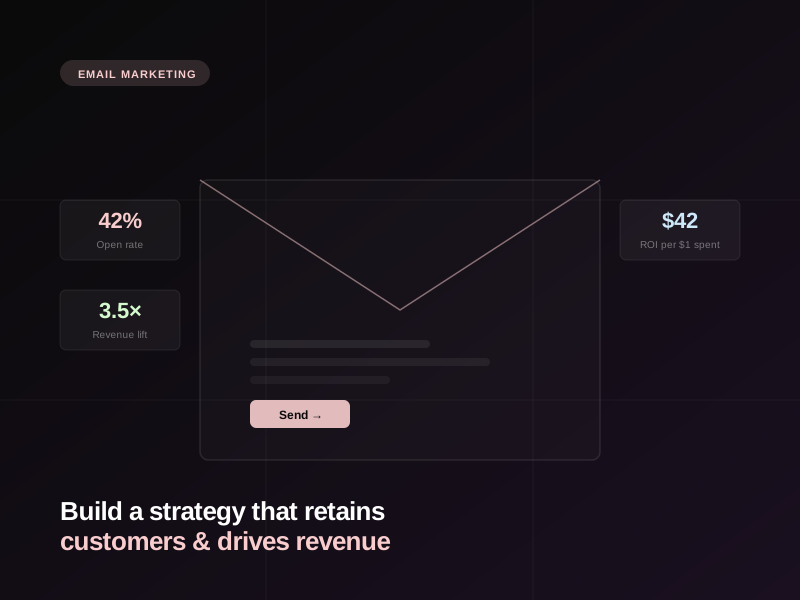
Email is the channel that keeps proving itself. The average email marketing programme delivers somewhere between $36 and $45 for every dollar spent — a ROI figure that no paid channel reliably matches. And yet, in the brands we audit, email is almost always the most under-developed part of the marketing stack.
The typical pattern looks like this: the brand has a Klaviyo account, they send a campaign occasionally, they have a basic welcome flow someone set up two years ago, and they have never seriously audited what it is generating. Meanwhile they are spending five or ten times more on Meta and Google trying to acquire customers they could be retaining far more cheaply.
Email is not glamorous. There are no flashy dashboards, no reach metrics to screenshot. But it is the channel that owns your customer relationship in a way no paid platform can. Your list is yours. No algorithm decides who sees it. No CPM increase can take it from you. That asset deserves to be built and worked properly.
Building and growing your list the right way
A healthy email list does not happen by accident. It requires deliberate list-building mechanics built into your site and your customer experience.
The baseline is a well-designed pop-up or sign-up form offering a clear value exchange — a discount, early access, useful content, or a genuine reason to subscribe. The value exchange matters: "Sign up to our newsletter" converts poorly in 2026. "Get 15% off your first order" or "Join our members list for early access and exclusive drops" converts meaningfully better.
Post-purchase list building is underused. Customers who have just bought from you are warm. A post-purchase opt-in — either through your confirmation email or an SMS opt-in prompt — captures subscribers at a moment of peak brand affinity. These subscribers tend to be more engaged and more valuable than pop-up captures.
What matters most in list building is quality over size. A list of 5,000 engaged subscribers who open and click consistently is worth more than a list of 50,000 disengaged addresses that suppress your deliverability. Resist the temptation to buy lists or use aggressive tactics that capture uninterested people. The maths always catches up with you in deliverability damage.
Segmentation: the multiplier for email performance
Segmentation is the practice of dividing your list into groups based on shared characteristics or behaviours, and sending each group relevant, targeted messages. It is the single highest-leverage improvement most brands can make to an existing email programme.
The starting point for any eCommerce brand is RFM segmentation: Recency (how recently did they purchase?), Frequency (how often do they buy?), and Monetary value (how much have they spent?). These three dimensions give you a powerful picture of customer value, and they map directly to the messages those customers should receive.
Champions (recent, frequent, high-value buyers) should receive VIP treatment — early access, loyalty rewards, genuine exclusivity. These are the customers who will refer others and whose LTV (lifetime value) justifies the investment.
At-risk customers (previously regular buyers who have gone quiet) need re-engagement campaigns. A well-timed "we miss you" sequence with a compelling offer can reactivate a meaningful percentage. Without segmentation, these customers receive the same campaign blast as everyone else — which is not the right message at the right time.
New subscribers and first-time buyers need an onboarding experience that builds familiarity and drives a second purchase. The period immediately after a first purchase or sign-up is the most important window for retention. What happens in the first 30 days has an outsized impact on whether someone becomes a repeat buyer.
"The brands generating 30–40% of their revenue from email aren't sending more campaigns. They're sending better campaigns to the right people at the right time."
The automation flows every eCommerce brand needs
Flows (automated email sequences triggered by customer behaviour or events) are the engine of email revenue. A good set of flows generates revenue continuously, without manual intervention, at a cost-per-acquisition that paid channels cannot match.
Welcome series (3–5 emails over 7–10 days)
Triggered when someone subscribes without purchasing. The welcome series is the most important flow for list-to-revenue conversion. Email 1 delivers the welcome offer and sets brand expectations. Emails 2–3 tell the brand story, introduce hero products, and build trust through social proof. Emails 4–5 create urgency if the welcome offer has not been redeemed. A well-built welcome series commonly converts 15–25% of new subscribers to first purchasers.
Abandoned cart series (2–3 emails over 24–48 hours)
Triggered when a customer adds to cart but does not complete purchase. This is the highest-ROI automation in eCommerce email. Email 1 is a simple, low-friction reminder — ideally sent within 1 hour of abandonment. Email 2 addresses potential objections (returns policy, shipping, reviews). Email 3, if needed, introduces a modest incentive. Abandoned cart flows typically recover 5–15% of otherwise lost revenue.
Browse abandonment (1–2 emails)
Triggered when a known subscriber views product pages without adding to cart. Lower urgency than cart abandonment, but captures earlier-stage intent. Keep it light — a single product recommendation email based on what they browsed, with no heavy-sell language.
Post-purchase series (3–4 emails over 30 days)
Triggered after a completed purchase. Email 1 is the order confirmation (already excellent for engagement — open rates are 60–70%). Email 2 is a shipping update. Email 3, sent after delivery, requests a review and surfaces complementary products. Email 4, at the 30-day mark, re-engages the customer and introduces a second-purchase incentive. Brands with a solid post-purchase flow see measurably better repeat purchase rates.
Winback or re-engagement (2–3 emails)
Triggered when a customer has not purchased or engaged for 90–180 days. These flows manage the tension between re-engagement and list hygiene — if someone does not re-engage after a winback sequence, sunset them from the active sending list to protect deliverability.
Klaviyo implementation note: Klaviyo is the platform we recommend for most eCommerce brands running on Shopify. Its native Shopify integration, predictive analytics, and segmentation depth are unmatched in its category. The flows above map directly to Klaviyo's trigger system. If you are on a different platform — Omnisend, ActiveCampaign, Mailchimp — the strategy is the same; the technical setup varies slightly.
Subject line best practices
The subject line determines whether the email gets opened. Here is what works consistently in 2026:
- Short and specific beats long and clever. Subject lines under 40 characters perform well on mobile, where the majority of emails are opened. Say what the email is about.
- First-name personalisation still lifts open rates. "Sarah, your cart is waiting" outperforms "Your cart is waiting" in most A/B tests. Use it, but only when the personalisation is accurate and natural.
- Curiosity gaps work, but only once. A subject line like "We need to talk..." earns an open once. Use it as a re-engagement tactic, not a regular campaign approach.
- Avoid spam trigger words. "FREE," "ACT NOW," "GUARANTEE" in all-caps, excessive exclamation marks — these are still deliverability risks. Write like a person, not a flyer.
- Test relentlessly. Klaviyo's built-in A/B testing for subject lines should be running on every major campaign send. The compound improvement from systematic testing is significant over time.
What to measure (and what to ignore)
Open rate has become an unreliable metric. Apple's Mail Privacy Protection, which automatically pre-opens emails to protect user privacy, inflates open rates significantly for brands with large Apple Mail audiences. Do not use open rate as a primary KPI.
The metrics that matter for eCommerce email in 2026:
- Revenue per recipient (RPR): Total revenue attributed to email, divided by the number of emails sent. This is the clearest measure of list quality and content relevance.
- Click rate: The percentage of sent emails that generated a click. This is a genuine engagement signal that open rate can no longer reliably be.
- Attributed revenue by flow: How much each automation flow is generating, in absolute dollar terms. This tells you where to invest optimisation time.
- List growth rate and unsubscribe rate: Net list health indicators. If your unsubscribe rate is climbing, your segmentation or sending frequency needs attention.
- Deliverability metrics: Spam complaint rate (target below 0.1%), bounce rate, and inbox placement rate. Poor deliverability silently kills email performance, and most brands do not watch it closely enough.
Email is not a set-and-forget channel. The brands extracting maximum value from it are reviewing performance monthly, iterating on flows, testing creative and copy, and keeping their list healthy. It is the highest-ROI channel in the stack. Treat it like it.