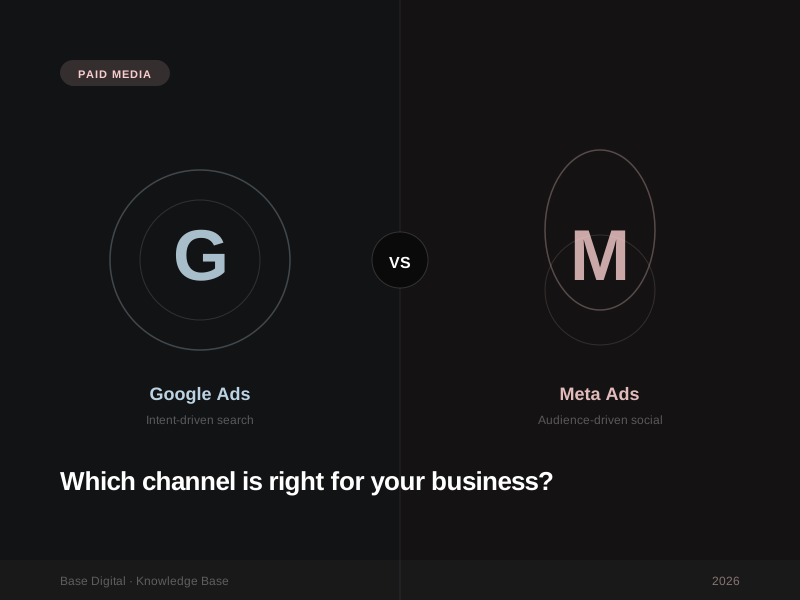
- Google Ads captures existing demand — people who are already searching for what you offer. Meta creates and amplifies demand.
- The right channel depends on where your customer is in the buying funnel and how they discover your category.
- Most established brands with meaningful budgets should be on both platforms — but with clearly differentiated strategies for each.
- Start with Google if you have a limited budget and search volume exists for your product or service. Start with Meta if you need to build awareness or your product requires education.
- The biggest mistake brands make is treating both channels identically and wondering why one "doesn't work."
Every week, someone asks me some version of this question: "Should we be on Google or Meta?" And every week, my answer is the same: it depends on your customer, your product, and where they are in the buying journey.
This is not a non-answer. It is the correct answer to a question that does not have a universal solution. Google Ads and Meta Ads are fundamentally different channels with different mechanics, different user mindsets and different roles in the marketing funnel. Understanding those differences — and making deliberate choices based on them — is what separates brands that scale paid media effectively from brands that burn budget wondering why their ads "don't convert."
The fundamental difference: intent vs audience
The clearest way to understand the Google vs Meta distinction is through the lens of intent.
Google Ads is intent-driven. Someone types a search query. That query is a signal — they are actively looking for something. "Emergency plumber Brisbane," "best accounting software for small business," "women's trail running shoes size 8." The moment a search happens, the buyer has self-identified their need. Your ad can appear at precisely the moment of maximum intent, and if your offer matches their search, the path to conversion is short.
Meta Ads is audience-driven. Nobody opens Instagram to find an emergency plumber. They are scrolling, connecting, being entertained. But Meta knows an extraordinary amount about who those people are — their demographics, interests, behaviours, life events, purchasing patterns. You can reach a very precisely defined group of people based on who they are rather than what they are searching for right now. The trade-off is that you are interrupting, not responding to, an existing intent signal.
This difference in user mindset has profound implications for creative, copy, landing page design, conversion rates, and how you measure success across each channel.
"Google captures what people already want. Meta creates awareness of what they didn't know they needed. Both are valuable — but only if you stop treating them as the same tool."
When Google Ads wins
Google Ads tends to be the stronger starting point when there is clear search demand for your product or service, the consideration-to-purchase window is short, and buyers are searching with high commercial intent.
High-intent service categories are the clearest case. If you are a dentist, a tradesperson, a legal firm, a specialist B2B service provider — people search for you when they need you. The search volume is there. The intent is there. Google Search campaigns are well-suited to capture it.
Google Shopping is similarly powerful for eCommerce when buyers are searching for specific product types. Someone searching "leather Chelsea boots brown size 10" is ready to buy. A well-optimised Shopping feed and a competitive cost-per-click means you can capture that purchase intent efficiently.
Google also tends to win on attribution clarity at the bottom of funnel. Because the click-through originates from an explicit search query, the intent signal is clear and the conversion path is relatively direct.
When Meta Ads wins
Meta becomes the superior channel — or at minimum, the essential complement — in several common scenarios.
When the search volume for your product category is low or non-existent, Google Ads cannot help you much. If you have invented a new product category, or you are selling something niche enough that monthly search volumes are in the hundreds rather than thousands, the demand capture approach does not apply. Meta lets you reach the right people based on profile and behaviour, and build awareness and desire from scratch.
When your product benefits from visual demonstration, Meta's ad formats are significantly stronger. Instagram and Facebook feed ads, Reels, Stories — these are visual, immersive formats that let product creative do the work. A fashion brand, a homewares brand, a food brand — the product sells visually. Meta's creative canvas is wider and more effective for this kind of category.
Meta is also the stronger channel for building remarketing audiences and nurturing buyers through longer consideration cycles. The ability to build custom audiences, lookalikes, and to sequence messaging across weeks or months is an advantage Meta holds over Google's Display and YouTube equivalents for most advertisers.
Decision frameworks by business type
eCommerce brands
Start with Meta if: your product is visual, impulse-driven, or discovery-based — beauty, fashion, homewares, food and beverage, gifting. Your creative quality and targeting precision will determine performance. Pair top-of-funnel prospecting (broad or interest-based audiences) with dynamic retargeting to website visitors and abandoned cart audiences.
Layer in Google if: there is meaningful search volume for your product category or brand. Google Shopping and Performance Max campaigns can capture lower-funnel intent cost-efficiently once you have a baseline ROAS target and a clean product feed.
Ideal channel mix for a growing eCommerce brand: 60–70% Meta (prospecting + retargeting), 30–40% Google (Shopping + brand search + Performance Max), with budget scaling based on ROAS performance by channel.
Service businesses (local and national)
Start with Google if: your service is actively searched for. Plumbing, legal services, financial planning, healthcare, education, recruitment — these categories have clear search intent. Google Search and Local Service Ads (where available) are the highest-leverage starting point for most local service businesses.
Add Meta when: your budget allows, to build local brand awareness, generate lead form submissions at lower CPL for less urgent services, and to run retargeting campaigns to website visitors who did not convert. For higher-ticket services — financial advice, building and construction, professional services — Meta retargeting to a warm website audience often delivers strong secondary conversion rates.
B2B brands
B2B is where both channels require the most strategic care, because buyer journeys are long, conversion events are not always on-platform, and decision-making is rarely individual.
LinkedIn is often the overlooked channel for B2B — but Meta (particularly Facebook) still performs well for many B2B categories where the target persona is reachable by job title, industry and employer size. The CPM on Meta is far lower than LinkedIn, which matters when you are working with B2B budgets that need to stretch.
Google Search is strong for B2B categories where buyers search actively — software, professional services, recruitment, IT. Brand terms and high-intent category terms can convert well. Performance Max for B2B requires careful audience signal feeding and should not be launched blind.
Budget reality check: For most businesses starting paid media with a budget under $5,000/month, running two channels simultaneously risks spreading too thin to get meaningful data from either. Pick the channel that best matches your buyer's mindset, run it properly for 90 days, then expand. Depth of execution on one channel almost always beats surface coverage of two.
The case for using both — strategically
For brands with the budget and infrastructure to run both channels well, the combined approach is consistently more powerful than either channel alone. The reason is full-funnel coverage: Meta builds the awareness and consideration that feeds into Google's intent capture. Buyers who encounter your brand on Meta and later search for you or your category on Google convert at higher rates than cold Google traffic. The channels amplify each other.
The strategic requirement is that you treat them as distinct channels with distinct KPIs, distinct creative strategies and distinct measurement frameworks — not as the same budget split across two platforms. The brands that struggle with both channels are usually treating them identically.
In practice: let Meta own the top of your funnel — reach, frequency, audience education, visual brand-building. Let Google own the bottom of your funnel — capturing buyers who are ready to act. Set your KPIs accordingly: Meta CPM, frequency and reach; Google conversion rate, ROAS and cost per acquisition. Then let the data tell you where to shift budget as you scale.
The question to ask before you decide
Before you make a channel decision, answer one question honestly: when my ideal customer decides they need what I offer, what do they do first? If the answer is "they search for it," start on Google. If the answer is "they see something on social, or a friend recommends something, or they stumble across it," start on Meta. That single question points you at the channel that matches your buyer's actual discovery behaviour — and that is always the right place to start.